OKVac

A name with possibilities.

Count the pieces. Keep the uncertainty attached.

The Kit Handoff Ledger is an administrative worksheet for a fictional equipment kit. It is not a maintenance or safety checklist. Its purpose is to make missing pieces and unanswered questions visible before someone signs off a record as complete.

Build the expected list

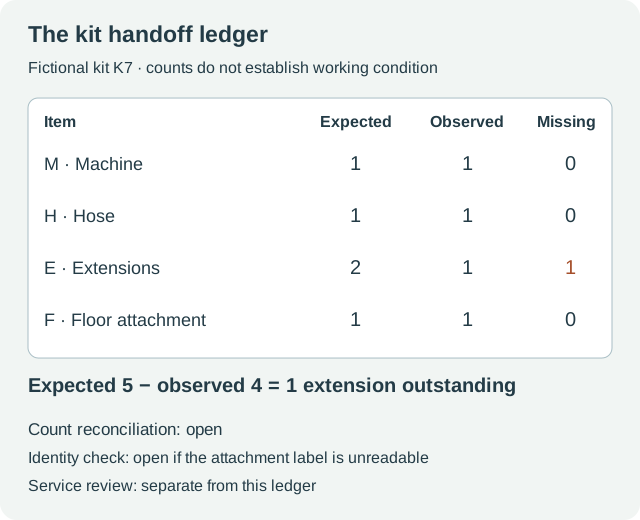
Start with kit ID, item ID, description, expected quantity, observed quantity and note. Fictional kit K7 lists one machine M, one hose H, two extension pieces E and one floor attachment F. The expected total is five physical pieces, across four item rows. Do not count the storage bag as part of that total unless it has its own row. Photograph references may help identify items, but a picture does not establish compatibility or working condition.
Reconcile a fictional return

At the invented return, M has one, H has one, E has one and F has one. The observed total is four pieces. Only the E row differs: two expected minus one observed leaves one extension piece outstanding. Record the difference beside E rather than writing a vague note that the kit is incomplete. The person handling the record can now ask for the specific missing piece without making any claim about why it is missing.

Separate three statuses

Use distinct fields for count reconciliation, identity confirmation and service review. In K7, count reconciliation is open because one extension is missing. Identity confirmation is also open if the returned floor attachment has an unreadable label. Service review remains outside this worksheet and should point to the relevant process rather than inherit a green status from the count. When the missing piece arrives, update its row and revision date; do not erase the unresolved identity question.

The kit handoff ledger
Illustrative reference for OKVac. The example is fictional. Scroll the diagram horizontally on smaller screens.